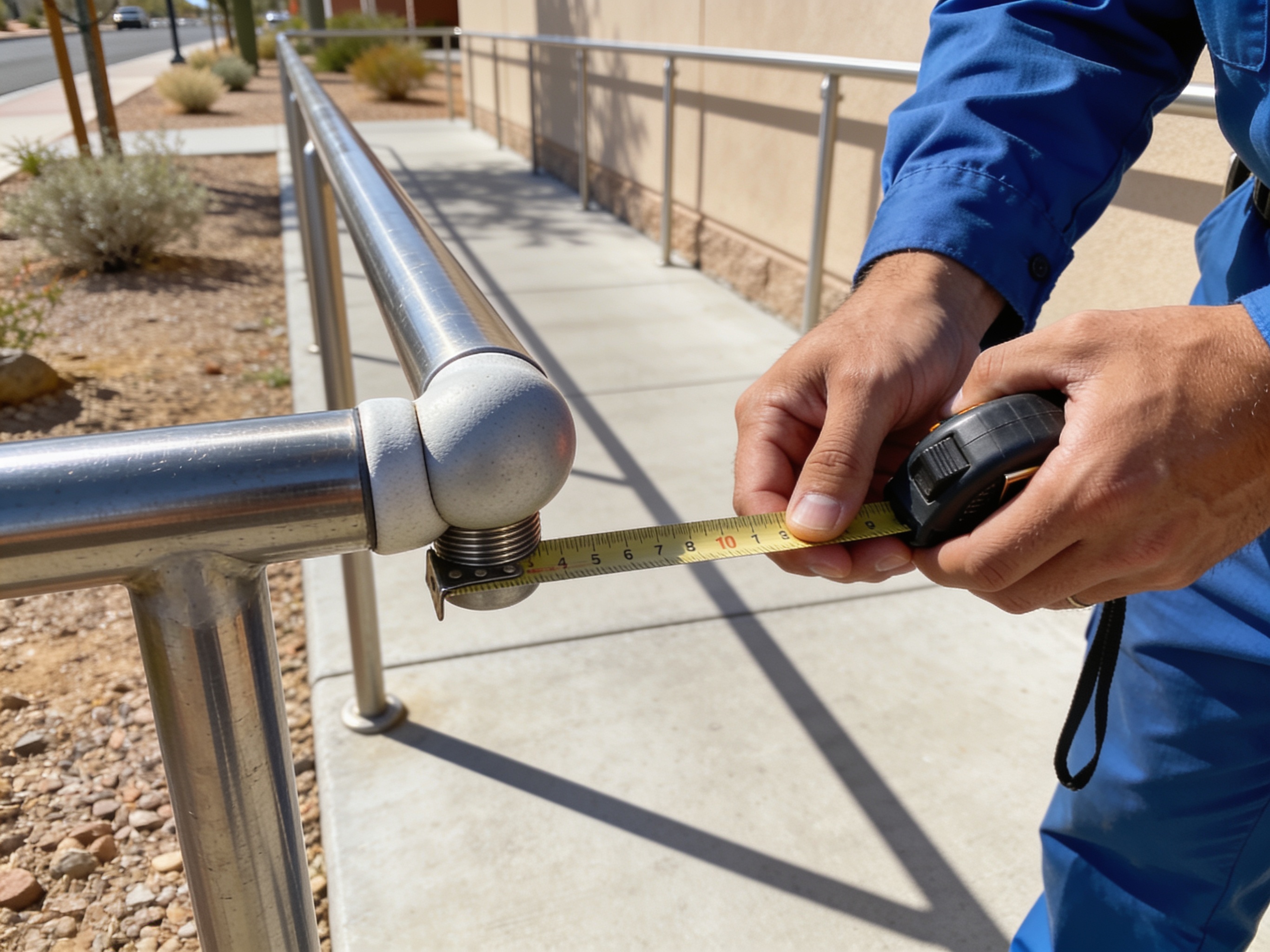
Commercial handrails in Phoenix must withstand constant UV exposure and temperature swings that reach well above 110 degrees in summer. In neighborhoods such as Biltmore and Camelback East, many office and retail buildings from the 1970s and 1980s require retrofits where original railings fail current ADA graspability and height rules. Stainless steel or powder-coated aluminum sections resist expansion and fading better than painted steel, and proper anchoring into concrete or masonry prevents loosening during monsoon rains common in Maricopa County.
Near landmarks like Chase Field and Papago Park, commercial projects often involve tight timelines around event schedules. Installers must coordinate with property managers to maintain egress paths while meeting 34-inch to 38-inch height standards and 1.5-inch maximum rail diameter. In areas like Ahwatukee and South Mountain, sloped sites demand custom bracket spacing to keep handrails level and graspable for the full length of ramps serving retail and medical tenants.
Contractors working in Maryvale and nearby Tempe and Mesa routinely encounter older stucco walls that crumble during drilling, requiring epoxy anchors instead of standard expansion bolts. Heat also affects adhesive cure times, so crews schedule heavy fabrication early in the day before pavement temperatures climb. These site realities directly influence material choice and installation sequence on every commercial ADA handrail job.
Technician insight
In Phoenix, the thing that catches most people out with commercial handrails ADA is how fast stucco and block walls degrade under extreme summer heat, so you often end up epoxy-anchoring every bracket instead of using standard expansion bolts, especially on buildings in Biltmore and Arcadia built before the 1990s.
Ramp Handrail Retrofit Near Chase Field
A downtown Phoenix office building needed updated railings on two exterior ramps before an upcoming event season. Site inspection showed original rails sat too low and lacked proper extensions. Crews fabricated stainless sections with custom brackets suited to the concrete substrate, installed them early morning to avoid peak heat, and verified all heights and returns met current ADA standards.
Commercial Handrails ADA Services We Offer
✓ADA Compliant Ramp Handrails
Custom fabrication and installation of double-line handrails on commercial ramps to meet slope and extension requirements in Phoenix retail and office settings.
✓Commercial Staircase Handrails
Replacement or new installation of code-compliant stair rails with proper returns and extensions for buildings throughout Biltmore and Arcadia.
✓Entrance and Lobby Railings
ADA-height railings at main entrances and lobbies of commercial properties near Camelback Mountain and Papago Park to improve accessibility.
✓Emergency Exit Handrails
Durable, high-visibility handrails along exit routes in Maricopa County warehouses and medical offices that must remain functional in extreme heat.
✓Corridor and Hallway Railings
Wall-mounted or freestanding railings for long interior corridors in Scottsdale and Tempe commercial complexes requiring continuous graspable support.
How it works
- 1
Site Evaluation
Measure existing conditions, note substrate type, and identify ADA clearance issues at the Phoenix commercial property.
- 2
Material Selection
Choose UV-stable finishes and anchor systems suited to desert heat and local building construction common in Maricopa County.
- 3
Fabrication And Layout
Cut and pre-assemble sections off-site to reduce on-site time during peak summer temperatures.
- 4
Installation And Compliance Check
Anchor rails to code heights, verify extensions, and confirm graspability before final walkthrough.
Pricing
Project pricing depends on linear footage, site access, and substrate conditions; quotes provided during Mon–Fri 8am–6pm or Sat 9am–2pm.